 SCDATA
Update
SCDATA
Update
SCDATA
Update
SCDATA
Update
Abstract: SCM HW 1.Objectives: (1)Experience the power of data anaIytics. (2)Aid us in our future career deveIopment. 2.Requirements: (1)Define Dream Jobs: Higher pay but lower effort, career path, job security (2)Region: Economically prosperous regions-job opportunities (Industrial Agglomeration, Resource Distribution, Employment Opportunities, Risks and Challenges) (3)Industry: future (Dividends, Growth Potential, Competitive Landscape) (4)Company: Profitability, growth, risk/financial health (Competitiveness, Profitability, Future Risks and Opportunities) 3.Tools: GCPS-Visible Tools Leo (Li Yuanhao) RUNIN SCM-3
 Dream Job Analysis
(Switzerland 2024)
By Region, Industry and Company
Leo (Li Yuanhao)
Learner of Supply Chain Management

Region (Where to Locate)


Median Revenue Analysis

Median Operating Income Analysis

Total Number & Revenue of Enterprise Analysis
Zürich significantly outperforms other cantons in Switzerland across core economic indicators such as enterprise agglomeration density, revenue scale, and economic vitality, and is widely recognized as the economic core of Switzerland.

Total Operating Income/Loss Analysis

Total Liabilities Analysis

Total Market Capitalization Analysis

Where to Locate-Zürich
From the comprehensive perspective of employment and economy, Zürich is the most outstanding canton in Switzerland.
Economic Scale and Industrial Competitiveness
The Canton of Zürich has the highest total market capitalization among all cantons in Switzerland. It gathers the Swiss Stock Exchange, the world’s largest gold trading center, and multinational financial giants such as UBS, Credit Suisse, and Swiss Re. The financial industry contributes 11% to Switzerland’s GDP, and the banking industry alone accounts for 6.7%, directly driving the growth of high-value-added jobs.
In addition to the financial industry, the Canton of Zürich also has industrial clusters in life sciences, information technology, and other fields.
Employment Opportunities and Labor Market
The Greater Zürich Area provides approximately 330,000 jobs, with 90% concentrated in the service industry (finance, technology, law, accounting, etc.). The financial industry directly creates a quarter of the local jobs and indirectly drives the growth of supporting service positions.
The unemployment rate in Zürich has long been lower than the Swiss average (the national unemployment rate was approximately 2.2% in 2023), and it attracts global talents with its high-quality life and international educational resources.
Comparison with Other "Highly Competitive Cantons"
Zug
Although it ranked first in the 2023 UBS Competitiveness Ranking, its advantage relies more on low tax rates to attract corporate registrations. Its industrial ecosystem is relatively single, and the employment scale is far smaller than that of Zürich.
Basel-Stadt
Centered on the chemical and pharmaceutical industries, its economic scale and employment diversity are not as good as those of Zürich, and the influence of the financial industry is limited.
Economic Resilience and Regional Radiation
Zürich contributes about 20% of Switzerland’s GDP and reinvests in infrastructure and education through capital gains and corporate taxes, further consolidating its economic advantages. Its diversified structure of "finance + technology + high-end manufacturing" shows stronger risk resistance amid global economic fluctuations.

Industry (which industry to enter)


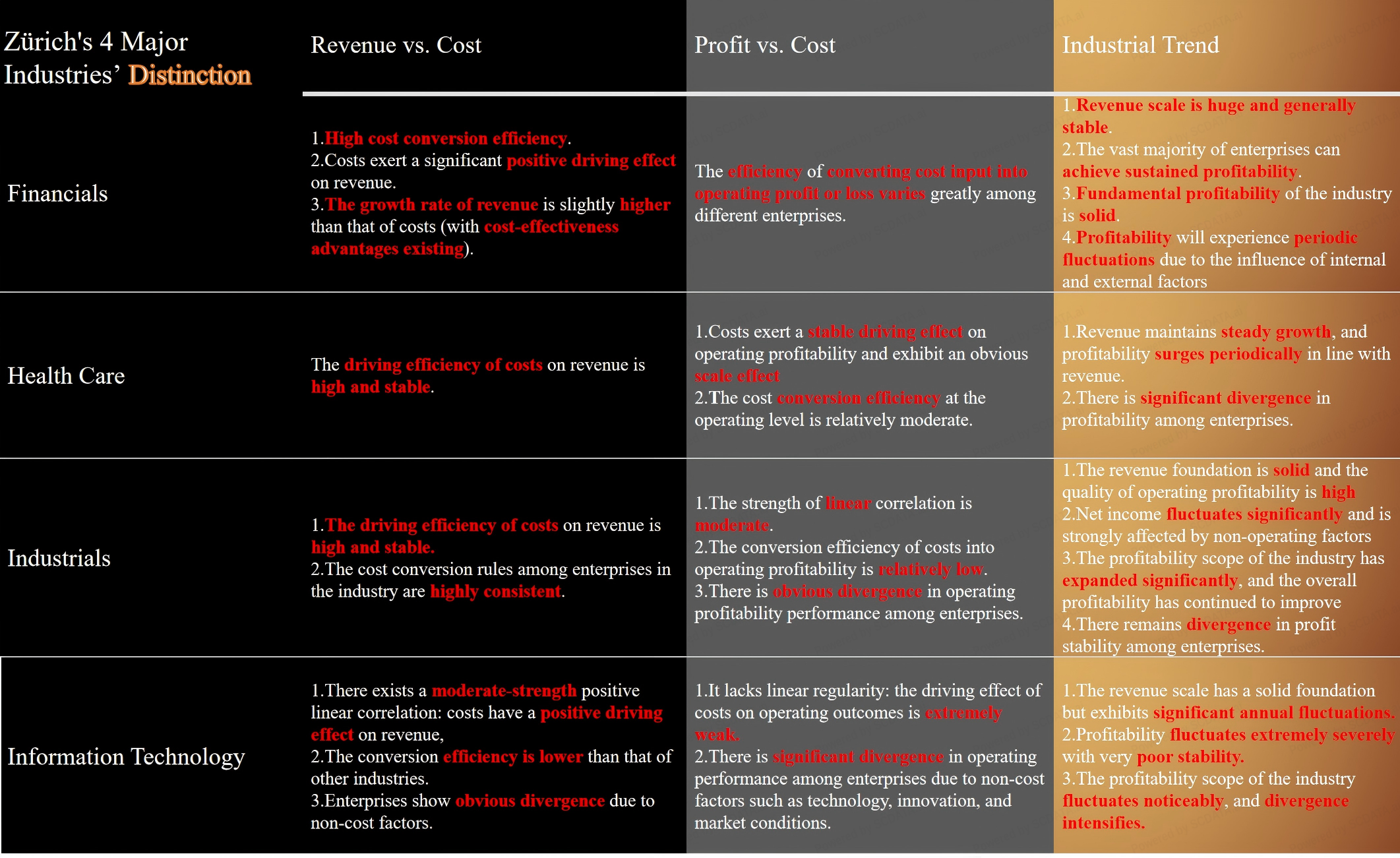
Industrial Analysis of Zürich

Company (which company to work for)

- Profitability (Gross Profit Margin, Net Profit Margin, ROE (Return on Equity), ROIC (Return on Invested Capital))
- Solvency (Debt-to-Asset Ratio, Current Ratio (Current Assets / Current Liabilities), Quick Ratio)
- Cash Flow Status (Net Cash Flow from Operating Activities, "Profit vs. Cash Flow" Matching Degree)
- Revenue and Profit Growth
- Sources of Sustainable Growth (Market Share Expansion; New Business Development)
- R&D Investment and Innovation
- Asset Turnover Efficiency (Total Asset Turnover (Revenue / Total Assets), Inventory Turnover (Cost of Goods Sold / Average Inventory))
- Supply Chain Efficiency ("Order Response Speed", "Supply Chain Cost Ratio")
- Human Efficiency (Revenue per Employee, Profit per Employee)
- Technological Barriers
- Brand Barriers
- Network Effects
- Scale Barriers
- Talent Attraction and Incentive Mechanisms
- Talent Retention Rate
- Presence of an Independent Board of Directors (to supervise management)
- Strict Compliance with Laws and Regulations
- Management's Long-Term Strategic Vision
- Reasonable Equity Structure, with Shareholders' Interests Aligned with the Company's Long-Term Development
- Social Risks: "Black Swans" (e.g., pandemics, wars)
- Market Risks: Raw Material Price Fluctuations, Exchange Rate Risks
- Operational Risks: Supply Chain Disruptions, Technological Iteration Risks
- Policy Risks
- NPS (Net Promoter Score)
- Repeat Purchase Rate
- ESG Performance (Environment, Social, Governance Performance)

Chubb Limited

One of the core enterprises in Switzerland's financial sector, and it has a significant scale advantage in the industry.
Both revenue and profit are high, and the profit quality is stable.
Revenue and profit increase simultaneously, and it has strong resistance to volatility.


